By Ed Staskus
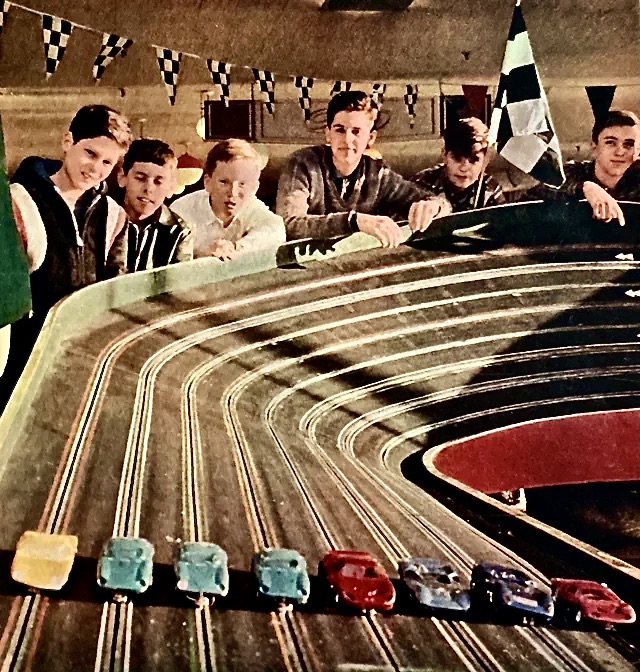
The best thing about living in North Collinwood the summer before I shuffled off to my freshman year at St. Joseph’s High School was the Race Place that had opened at the beginning of the year on E. 185th St. It was a five-minute walk away. It was in what had once been a corner candy store. On one plate glass window was plastered “Speed Action Fun Excitement!” The other window said, “Come in! This is where it’s all happening!” Inside the front door was a counter, some stools along the near side wall, pinball machines on the other wall, and an eight-lane racecourse. The track was laid out on top of sheets of plywood that were set on saw horses.
None of my friends nor I were ever given permission to knock together a boy cave at home. The home of slot car racing was the next best thing. We made Race Place our home away from home.
The track was bare bones, There were no pretend bushes or trees. There were no miniature buildings. There were no trains tooting their friendly way to the next station. Racing slot cars was girding your loins and going fast as hell, leaving the other guy eating your dust. It was thrills and spills sans real blood. No bones got broken, although feelings got bruised black and blue every day.
A man wearing a pork pie hat, and smoking a cigar more often than not, sat on a stool behind the counter. His name was Ralph. Sometimes he wore a t-shirt that said, “I Like Beer and Maybe Three People.” He never said hello or goodbye. Nobody knew where he lived or how old he was. Nobody knew what he looked like, exactly, behind the cloud of stogie smoke obscuring his face. He took our spare change in return for time on the track, which was by the quarter hour, rented shabby slot cars to the poverty-stricken, and sold 10-ounce bottles of Coke from a cooler behind him.
There was a poster on the wall next to the cooler. It said, “Drink Coca-Cola.” The picture was of a cutie pie smiling from ear to ear and dressed like a princess in a low-cut white dress, wearing forearm gloves, and a jewel-encrusted crown. There was a bottle of Coca-Cola in her hand. “Refresh…Add Zest” was written at the bottom of the poster.
Slot cars are miniature electric powered race cars guided by a slot in the track on which they run. The cars are 1:32 scale. A blade extends from the bottom of the car into the slot. We used hand-held squeeze controllers to speed up and slow down the low-voltage motors inside the cars. The front wheels ran with the post in its guide-slot, but the rear wheels were free to drift and slide. When they started to slide was when you wanted to put metal to the petal. When you got it right was when the car ended up pointing straight down the straightaway coming out of a curve. The challenge was taking curves as fast as possible without losing your grip of the slot and spinning out. When that happened you de-slotted, flying off the track, everybody ducking out of the way and laughing their heads off.
I went to the slot car track with my friends, who were Ignas, Gediminas, Justinas, and the two Tommy’s. Everybody called Ignas Iggy. We called Gediminas Eddie while Justinas was just himself. He tried on several nicknames, but we told him nicknaming yourself was not cool. Tommy One Shoe and Tommy Two Shoes were twins. For some reason nobody ever found out, their mother named both of them Tommy. She was a no-explaining woman. They were Irish, not Lithuanian like the rest of us. The twins were hard to tell apart at the best of times, until the morning one of them forgot one of his shoes. By the time he boarded the CTS bus to school it was too late. He shuffled around all that day wearing one shoe and wearing a hole in his shoeless sock. The nuns didn’t bother hitting him with their rulers. They shook their heads, instead. “Poor little retard kid,” one of them whispered to another. He was so embarrassed a red dot like a freckle popped up on the tip of his nose. The next day it was still there. It never went away. After that there was no trouble telling the twins apart.
Our slot cars were fast as lightning, close to 15 MPH flat out. The scale miles were more like 500 MPH. The cars were always shooting off the track. Everybody had nitro on the brain and wanted to go faster and faster. “If you’re in control you’re not going fast enough,” is what Tommy Two Shoes said. “Straight roads are for fast cars,” Tommy One Shoe said in return. “Turns are for fast drivers, like me.” Whenever Two Shoes took on One Shoe head-to-head, One Shoe always won.
“What’s behind you doesn’t matter,” he told his brother every time he won. He was the fastest thing on four tiny wheels. He started wearing a phony racing car helmet. He took a lot of teasing about it, but didn’t seem to care.
“Run your car, not your mouth,” Tommy Two Shoes retorted. He rubbed castor oil on the warmed-up engine of his Lotus-Ford to make it smell more authentic. He added racing emblems from a decal sheet. There was an itsy-bitsy driver in the open cockpit. Itsy-bitsy was modeled after Graham Hill. Tommy painted a devil-may-care whisker-thin moustache on it. He was turning himself into the Smokey Yunick of the slots, improvising and modifying. No matter what he did, though, he couldn’t beat his brother’s yellow Mustang with ‘The Boss’ emblazoned on the sides of it. The pony car was nearly unbeatable with Tommy One Shoe in the driver’s seat.
He was training for the National Ford-Aurora Model Motoring competition. First prize was a full-size Thunderbird Sports Roadster. “If I win I might let my dad drive it sometimes,” he said. “I know I can do it. I’m going to be numb to the competition.” He was 12 years old. If he won he was going to be the only grade schooler in the world with his own real-life muscle car.
The first toy racing cars made by the Lionel Train Company rolled off the assembly line in 1912. They were powered by raised electric rails. Then World War One happened. The assembly line stopped dead. In 1938 Bachman Brothers made the “Motorcycle Cop & Car Speedway.” it was a single track with vehicles made from tin. Two keys were included, and the cars were powered by winding them up with the keys.
After World War Two British hobbyists began to toy with them again, except this time they fitted them with handmade stop-gap motors. The motors were the size of a dime. A fragment of iron was the magnet. In 1954 Great Britain’s Southport Model Engineering Society built an electric slotted course nearly 60 feet long. “Slot car” was coined to set the new racers apart from the earlier “rail cars.”
The summer that I burned up the neighborhood race track and destroyed two slot cars by virtue of aggressive cornering and excessive speed, there were close to 4,000 tracks in the country. Revell, Scalextrix, and Aurora were selling hundreds of millions of dollars’ worth of cars and equipment annually. Boys’ Life magazine had slot cars written about and advertised in every edition.
Ed Shorer, the only Jewish kid in our neighborhood, with a head of thick curls and quick hands on the controller, couldn’t get enough of his new hobby. “I was ditching Hebrew school one day when I was 12 years old and I wandered into a hobby shop,” he said. By the time he left he was hooked. “As a result, I never got my bar mitzvah.”
Scalextric came out with models fashioned after the Maserati 250F and the Ferrari 375. Their Grand Prix-themed cars were unbeatable, at least until they went up against Aurora’s Model Motoring line-up. By 1963 the Aurora Thunderjet-500 was the slot car to beat. When push came to shove, however, success on the track came down to who had the hot hand on the controller.
Whenever the competition got over-heated among us we heard Ralph at the counter somewhere behind his cloud of stogie smoke break in, “All right, boys, the No. 1 rule is have fun.” He was oblivious to who had the hot hand.
“I have more fun when I win,” Tommy One Shoe declared, not paying attention to the ruckus, and never taking his eyes off the track.
I had a Cleveland Press paper route that paid the piper. I was blowing through my savings, but I couldn’t help myself. I delivered my papers in the afternoon as fast as I could, never breaking stride, hurling rubber-banded newspapers out of my shoulder-slung bag onto porches. I never looked back to see if any of them rolled into the bushes. As soon as I was done I hustled to the slot car track, where I raced until dinnertime, when I hurried back home. My parents were by-the-rules Eastern Europeans and my sister, brother, and I were expected to be in our seats for cold beetroot soup and cepelinai, otherwise known as potato dumplings with a meat center, exactly on time. We ate our zeppelins larded with sour cream and pork cracklings.
By the middle of summer I was delivering my newspapers faster than ever. Lines had been forming at the slot car raceway. Everybody and their brother wanted in on the action. Polk’s Model Craft Hobbies, the biggest hobby store in New York City, estimated it was becoming as popular as model railroading. There was a new 475-foot track in nearby Long Island. Elvis Presley raced there, not that it mattered. We didn’t listen to his songs anymore since he had become a movie star. We were listening to Jan and Dean.
“We both popped the clutch when the light turned green, you should have heard the whine from my screamin’ machine, Dead Man’s Curve, I could hear ‘em say, won’t come back from Dead Man’s Curve,” Jan and Dean warned.
Labor Day weekend that summer was the weekend of our slot car blow-out. Most of us were going to start high school the following Tuesday. We didn’t know if or when we would be racing again. The Cleveland National Air Show came back to town that weekend, after a fifteen-year hiatus, but no matter how many Blue Angels did however many aerobatic tricks we were going to be doing our own kind of high-flying. We got started on Saturday morning and wrapped it up on Sunday afternoon. Inside the Race Place we didn’t hear a even one sonic boom all weekend.
We made up our own order of the day, which was a round-robin tournament. There were eight of us. Ralph smoothed the way by letting us have two slot lanes for the weekend. By the end of Saturday Tommy One Shoe and I were on top of the leader board. By Sunday afternoon everybody else was out and there was one last do-or-die race left. Tommy One Shoe lowered his pony car into the inside slot. I lowered my Scalextric Shelby Cobra into the slot next to the Ford Mustang. The race was set for ten laps.
“One, two, three, go!” Iggy called out from a stool behind us. He was acting as referee, even though he didn’t know refereeing from a hole in the wall. He had brought a small, checkered flag with him that he waved around like a matador.
I was a year older than Tommy One Shoe and no greenhorn on the track, but I never stood a chance. I didn’t know he practiced day and night on his own homemade track. I didn’t know he rehearsed going into turns and coming out of them. I didn’t know he used fine grit sandpaper to rough up his wheels to improve their handling. By his standards I was a babe in the woods, which is where I ended up.
I also didn’t know he had upgraded the magnets on his car. He wasn’t going to be flying off the merry-go-round anytime soon. No sooner did I fall behind a half-lap after three laps than I was forced to speed up. It didn’t do me any good. After seven laps I was behind by almost a full lap. I sped up some more. My Shelby was screaming down the track, but every time I checked on Tommy’s Mustang, he was inching farther ahead.
I knew my goose was cooked. I inevitably de-slotted, flipping high up into outer space. My car went crashing into the far wall, where the body of it broke away from the chassis, and the engine fell behind a pinball machine. Tommy One Shoe slowed down on the last lap, took a victory lap, jumped up on his stool, and raised his arms above his head making V’s with his fingers. The stool wobbled and toppled over. Tommy went head over heels, but Ralph was walking past and snagged him out of the air by the back of his collar before his phony helmet hit the floor.
“Watch your step, champ,” he said, setting him straight.
When high school started I still raced weekends and over the Thanksgiving and Christmas holidays, but after the New Year I put my slot gear away. I had gotten straight A’s all through grade school without even trying. Halfway through my freshman year I was getting straight C’s without even trying. My parents made sure to let me know they were unhappy. Slot car racing was in my blood but I could see the handwriting on the wall.
Tommy One Shoe entered and won slot car races all over northeastern Ohio for a few years but never won the Ford Thunderbird he wanted. I thought he might be disappointed after all the work he had put into his hobby, but I was wrong. “Winning isn’t the point, even though somebody has got to get to the finish line first,” he said. He had become a philosopher as well as a slot car champion.
“Wanting to win is the point,” he said.
Ed Staskus posts monthly on 147 Stanley Street at http://www.147stanleystreet.com, Made in Cleveland at http://www.clevelandohiodaybook.com., Atlantic Canada at http://www.redroadpei.com, and Lithuanian Journal at http://www.lithuanianjournal, com. To get the site’s monthly feature in your in-box click on “Follow.”
More short stories can be found at Ed Staskus WordPress. His books are available on Amazon and Apple Books.
“Bomb City”
Cleveland, Ohio 1975. The John Scalish Crime Family and Danny Greene’s Irish Mob are at war. Car bombs are the weapon of choice. Two police detectives are assigned to find the bomb makers. It gets personal. Revenge is always personal.
A Crying of Lot 49 Publication